
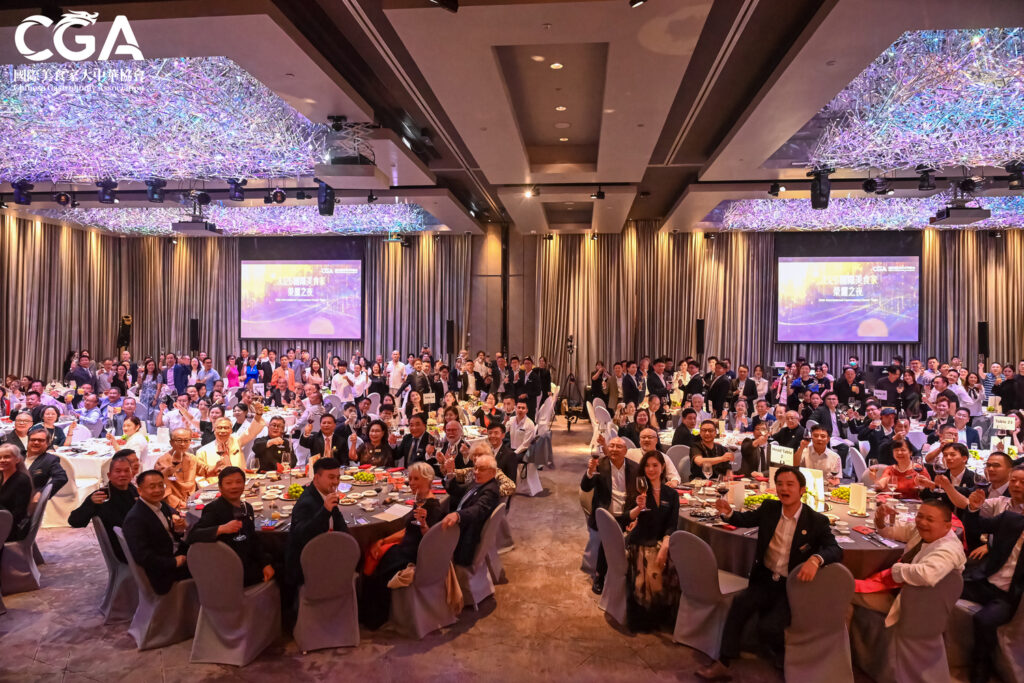
The 2026 International Gastronomy Symposium in Hong Kong, organised by the Chinese Gastronomy Association (CGA) and hosted by The Hong Kong Polytechnic University, turned out to be a remarkably hospitable table for gastronomy, in both the literal and the intellectual sense. Around that table, modern science, clinical nutrition, technology, Traditional Chinese Medicine, inherited food knowledge, philosophy and cultural belief were all given room to speak. Although the meeting took place in Hong Kong and naturally drew particularly strong participation from Hong Kong, Shenzhen and the Greater Bay Area, its ambition was broader: it was conceived as an international symposium for China and as a meeting place between Chinese and international approaches to gastronomy.
Around 600 participants, scholars from 14 universities and 19 sessions gathered around three main themes: gastronomy and health, with particular attention to longevity; gastronomy, innovation and technology; and gastronomy, place branding and development. The scale was impressive, but conferences are rarely remembered for their numbers. They are remembered for the moments that make one stop, look again and occasionally reconsider something one thought one already understood.
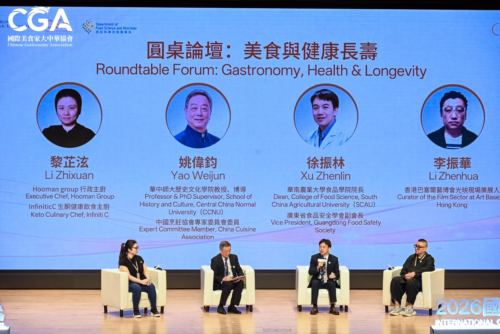
Much Western academic research has achieved extraordinary precision by drawing boundaries. Nutrition is distinguished from medicine, medicine from religion, empirical evidence from inherited belief, and physiological effects from cultural meaning. This division of intellectual labour has been enormously productive: it has allowed us to measure, compare, test and explain with a degree of precision earlier generations could hardly have imagined. Many of the Chinese contributions we encountered in Hong Kong, however, seemed less concerned with keeping all these categories in their proper academic boxes.
The programme itself was revealing. Within the same discussion of gastronomy, health and longevity, and clinical nutrition appeared alongside Traditional Chinese Medicine, while the broader conversation ranged across inherited food knowledge, philosophy, culturally embedded beliefs and ideas of balance and harmony developed over centuries. Food could consequently be discussed simultaneously as nourishment, pleasure, medicine, cultural inheritance and a means of maintaining bodily and mental balance; particular ingredients and edible organisms could be associated with seasons, bodily conditions, warming or cooling properties, recovery, strength or wellbeing. Some such claims would, in a Western university, immediately be allocated to separate departments. Others might not be allowed through the departmental door at all. In Hong Kong, the intellectual borders appeared more porous, and that deserves to be taken seriously.
This would be badly misunderstood as an absence of science. On the contrary, the symposium was filled with modern research on medicine, nutrition and technology. The interesting point was that science appeared within a larger ecology of knowledge. Experimental and clinical perspectives sat alongside traditional medicine, accumulated experience, philosophy, inherited cultural beliefs and a broader cultural horizon shaped, among other things, by Buddhist and Taoist traditions. To Western ears, some of these elements may sound scientific, others philosophical, medical, symbolic or spiritual; the perspectives encountered at the symposium did not always seem to require us to decide quite so quickly which drawer each of them belonged in.
That may be intellectually useful. It allows questions to be asked that a stricter scientific division of labour sometimes excludes before enquiry has even begun: can food comfort as well as nourish; can a meal affect mental wellbeing as well as metabolism; can inherited knowledge contain observations that modern science has not yet formulated, or perhaps has not yet thought worth testing; and can pleasure itself be part of health rather than merely a suspicious side effect of eating? Such questions are not grounds for abandoning scientific scrutiny. Quite the opposite: they enlarge the field of what we consider worth scrutinising.
The hospitality of the symposium was not only intellectual; it was also remarkably tangible. Around sixty students had been mobilised as conference hosts and guides, and their enthusiasm, courtesy and apparently inexhaustible ability to make international delegates look as though they knew exactly where they were going contributed greatly to the atmosphere of the meeting. Academic conferences depend on ideas, of course, but they also depend on people who know where the next room is. In this sense, the students did more than help the conference run smoothly: they helped create the openness and generosity that characterised the symposium as a whole.
This broader intellectual ecology was particularly visible in the discussions of longevity. In much Western research, longevity rather quickly becomes a matter of biomarkers, nutrients, medical interventions and measurable outcomes. All of these are important. In Hong Kong, however, longevity repeatedly appeared as part of a larger configuration involving food traditions, preparation, balance, social practices, pleasure and ways of living. The question was therefore not only how long we can live, but how we should live while doing it. Three of us, having already passed eighty, listened rather attentively at this point. We hesitate to present ourselves as scientific evidence but remain available for continued longitudinal observation.
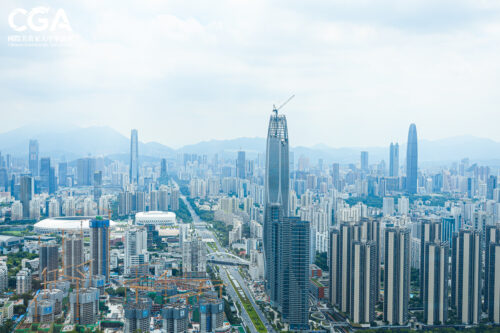
Shenzhen then provided a useful corrective to anyone tempted to imagine this concern with inherited knowledge as nostalgia for an ancient past. On 4 September the international delegation visited the former small market town in the Pearl River Delta that, after becoming China’s first Special Economic Zone, developed in less than half a century into a global megacity approaching twenty million inhabitants. For us gastronomes, two moments stood out. One was an outstanding Cantonese luncheon at Xifu Liun Atelier, where the cuisine was matched by a striking contemporary architectural setting, museum-quality art and remarkable views. The other came at the CGA headquarters, where we were introduced to automated cooking technology. We watched kitchen robots prepare five dishes for roughly thirty people in about thirty minutes, using systems with intelligent temperature control, standardised output and self-cleaning, in formats intended for restaurants, institutional kitchens and even domestic use. For a group of gastronomes it was rather like being introduced to a new species. We observed the machines with professional curiosity, considerable admiration and perhaps a slight concern for the future employment prospects of some of our chef friends.
Yet the demonstration made an important point: the robots were not presented as an escape from culinary tradition, but as a means of translating recipes, temperature, seasoning and cooking sequences into digital processes. The Shenzhen demonstration therefore did not present the future of gastronomy as a choice between ancient tradition and advanced technology; it was perfectly prepared to have both at the same table. A robot can, as our taste buds can testify, reproduce a recipe quite competently. Whether it can develop gastronomic judgement remains an open question. For the time being, at least, there is still some work left for the rest of us.
It is tempting to describe all this as Western science meeting Eastern wisdom, and there is something in that formulation, but it is also too neat. Western gastronomy is not merely scientific and analytical; it contains tradition, ritual, religion, pleasure and inherited knowledge. Nor is Chinese gastronomy somehow pre-scientific. The Hong Kong symposium demonstrated precisely the opposite: sophisticated science and technology were everywhere. The difference we sensed was subtler and concerned the boundaries around legitimate knowledge. Western research has become exceptionally good at taking complex phenomena apart. Many of the Chinese contributions suggested a greater willingness to begin with relationships: between food and body, season and health, pleasure and wellbeing, tradition and innovation, individual experience and a wider way of life. Perhaps that is why the symposium felt intellectually refreshing. It did not ask us to abandon what Western science does well; rather, it invited us to consider whether some of the connections we separate analytically may eventually have to be put together again. This idea resonates strongly with the wider challenge facing gastronomy as an emerging international field of knowledge.
For AIG’s Scientific Committee, Hong Kong was one stage in an ongoing international conversation. Stockholm asked where gastronomic knowledge is produced; Madrid explored how a fragmented field might be reframed; and Belém brought gastronomy into conversation with biodiversity, regionality and sustainability. Hong Kong added something different: what happens when different traditions disagree not only about the answers, but also about what kinds of knowledge should be invited to the table? That is a more interesting question than deciding whether East or West is right. Perhaps the most encouraging impression we brought home from the China symposium in Hong Kong was precisely that the perspectives we encountered deserve to be taken seriously because they did not simply reproduce the dominant Western research agenda. They may ask different questions, admit different forms of evidence and make connections that our own disciplinary divisions have taught us not to see.
A genuinely international gastronomy research community should not require everyone to think in the same way. It should make all of us slightly less certain that our own way is the only sensible one. After all, a meal may be scientifically analysed, nutritionally optimised, beautifully presented and technologically flawless, and still benefit from a little wisdom. Preferably, of course, before dessert.